You land in Istanbul, Cairo or Dubai with a laptop, a rental agreement to sort out and a bank that wants to talk to you by phone. Your home SIM roams at painful rates, the local SIM needs a passport scan and a three-day activation window, and the "free" calling app you rely on cannot reach a landline at all. This is the part of expat life nobody puts in the brochure. Dialable (https://www.dialable.world) exists for exactly this moment: an audio-only phone service that runs in a browser tab, so you can place a real call to a real number without installing anything or swapping a SIM.
This guide covers three of the most requested destinations for expats, remote workers and regional business owners: Turkey, Egypt and the United Arab Emirates. It explains how to dial each one correctly, what to expect on call quality, and how a browser-based service compares with the alternatives. If you have been looking for a Skype alternative for landline calls, or a way to make cheap international calls to landlines without a contract, read on.
Key Takeaways
- Turkey (+90), Egypt (+20) and the UAE (+971) all have both mobile and landline numbers, and many official offices, clinics, utilities and small businesses are reachable only by landline.
- Dialable lets you call from browser: open the page, enter the number, talk. No app download, no SIM, no account juggling.
- Dialable is audio-only. It does one thing, a voice call to a phone number, and does it without extra features to configure.
- "Free" app-to-app calling only works when the other person also has the same app. A landline owner never does.
- Check the per-minute rate shown before you dial, and use a headset on a stable connection for the clearest voice quality.
Why is calling Turkey, Egypt and the UAE from abroad so awkward?
Three habits of the region collide with the way most people call internationally.
First, a lot of daily life still runs on the phone. A Turkish tax office, an Egyptian notary, a Dubai property management company or a family clinic often lists a landline and nothing else. Email may be answered in days; a phone call gets an answer in minutes.
Second, the apps people lean on have gaps. WhatsApp calling is excellent when both people have WhatsApp and a data connection, but it cannot dial a number that belongs to a desk phone. Skype, once the default way to ring a landline from a laptop, was shut down by Microsoft in May 2025, which left many people hunting for a replacement. A true global call tool has to reach the old telephone network, not just other app users.
Third, the SIM route is slow. Local SIM registration rules differ by country, and tourists or newly arrived residents can wait days before a number is usable. Meanwhile your appointment is tomorrow.
What does "call from browser" actually mean?
Two terms are worth defining before we go further.
WebRTC (Web Real-Time Communication) is an open standard built into Chrome, Firefox, Safari and Edge that lets a web page capture your microphone and send audio over the internet in real time, with no plugin. VoIP (Voice over Internet Protocol) is the broader idea of carrying phone calls as internet data instead of over copper lines.
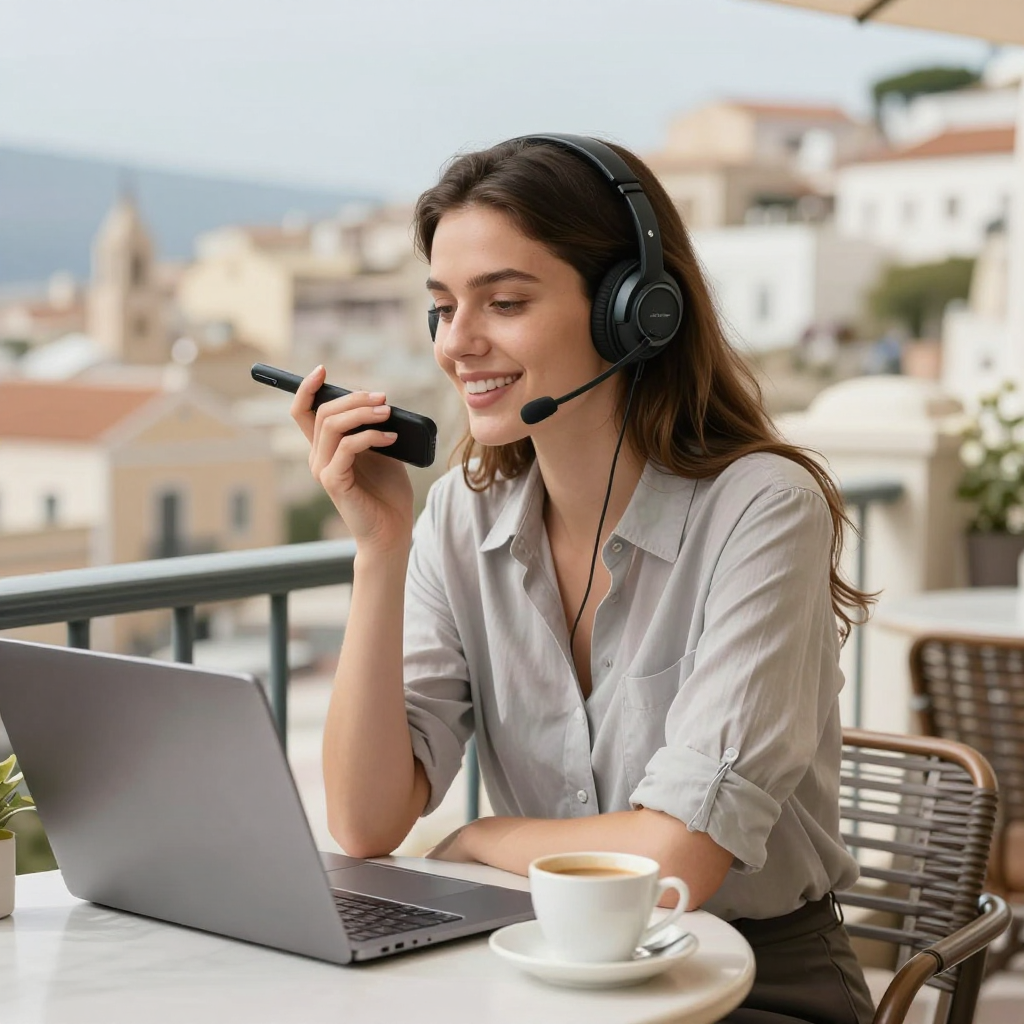
Here is how a Dialable call works in practice. Your browser captures your voice with WebRTC and compresses it with a codec (a program that squeezes audio into small packets; WebRTC commonly uses one called Opus, which can work anywhere from about 6 kbit/s up to 510 kbit/s). The audio travels over the internet to a gateway, which hands the call to the PSTN (Public Switched Telephone Network, the worldwide system of landline and mobile carriers). The person you are calling just hears an ordinary phone ring. They do not need an app, an account or a data plan.
That is the whole trick, and it is why a browser tab can dial a rural Egyptian landline.
How do you dial Turkey correctly?
Turkey's country code is +90. Mobile numbers in Turkey start with a 5 after the country code (for example +90 5xx xxx xx xx), while landlines use an area code: Istanbul has two, 212 for the European side and 216 for the Asian side, and Ankara uses 312.
The classic mistake is copying a number as locals write it, with a leading 0 for domestic calls. When you dial internationally, drop that leading 0: write +90 212 ... and not +90 0212 .... The same rule applies in many countries, and it is the single most common reason an international call fails to connect.
Turkey is on UTC+3 all year with no daylight saving changes, which makes scheduling easy: your counterpart's office hours do not shift twice a year. Government offices typically work weekday business hours, so plan calls for the morning there.
How do you call Egypt and the UAE?
Egypt's country code is +20. Cairo landlines use the area code 2, so a Cairo desk number looks like +20 2 xxxx xxxx, and Egyptian mobiles start with a 1 after the country code (for instance +20 10x, 11x, 12x or 15x). Alexandria uses area code 3. As with Turkey, drop any domestic leading 0 when you dial from abroad.
The UAE's country code is +971. Dubai landlines begin with 4 after the country code (+971 4 xxx xxxx), Abu Dhabi uses 2, and mobiles begin with 5 (+971 5x xxx xxxx). The UAE standard working week has been Monday to Friday with a shorter Friday for many employers, and the country sits on UTC+4 with no daylight saving, so a morning in Dubai is mid-evening in much of North America. Always confirm time zones before an important call, because a missed window can cost a full day.
Is it really cheaper than roaming or a hotel phone?
Roaming charges and hotel switchboards are the usual budget killers. Pay-as-you-go browser calling changes the maths, because you pay for talk time to the destination rather than for a monthly plan you barely use. Here is the general shape of the comparison.
| Option | Reaches a landline? | Needs an app or SIM? | Typical cost pattern | |---|---|---|---| | Home-carrier roaming | Yes | SIM you already own | Per-minute roaming surcharges, often the most expensive | | Hotel room phone | Yes | No | Hotel-set per-minute fee, frequently marked up heavily | | App-to-app calling (WhatsApp) | No | App on both ends | Free, but only to other app users | | Local SIM | Yes | New SIM and registration | Cheap per minute, but days of setup | | Dialable | Yes | Browser only | Pay for talk time, rate visible before you call |
We deliberately avoid quoting a single rate here, because per-minute prices differ between landline and mobile destinations and can change. The point is the pattern: when you only need a handful of calls, such as a bank, a clinic, a landlord and a courier, paying only for those minutes is almost always cheaper than a plan. Check the rate on the Dialable page for your exact number, then decide.
What is call quality like over a browser?
Voice quality depends mostly on three things you control.
- Latency, the delay between you speaking and the other person hearing it. The ITU (the United Nations body that sets telecom standards) recommends keeping one-way delay under about 150 milliseconds for conversation that feels natural. Wired or good Wi-Fi connections on a nearby server usually stay in that range; a congested café network may not.
- Bandwidth. A voice call needs very little, far less than streaming music. A stable connection of even a few hundred kbit/s is plenty for audio.
- Your microphone. A cheap wired headset beats a laptop's built-in mic in a noisy room, and it stops the other party hearing keyboard clatter.
Because Dialable is audio-only, there is no heavy media stream competing for your bandwidth. Every kilobit goes to your voice. If a call drops quality, switch from café Wi-Fi to a phone hotspot, close bandwidth-hungry tabs, and retry.

What kinds of calls do people actually make?
- Housing and utilities. Landlords, estate agents, electricity and internet providers across Istanbul, Cairo and Dubai often only answer a landline.
- Banks and cards. A fraud alert or a frozen card sometimes needs a voice conversation with your home bank or with a branch abroad.
- Healthcare. Booking a clinic slot or confirming an insurance pre-approval by phone.
- Business. Following up suppliers, freight forwarders and clients who prefer a phone number to a chat handle. If you run a small team, this is a useful global call option without buying hardware.
- Family. Calling a grandparent who has a landline and no smartphone.
If you are an expat or a freelancer working across time zones, keeping one tab open for voice calls is simpler than carrying three SIMs.
Tips before you dial
- Write the number in full international format: plus sign, country code, then the number without a leading 0.
- Test your microphone permission in the browser before an important call.
- Use headphones to avoid echo, which happens when the other person's voice leaks from your speakers into your microphone.
- Confirm the other party's local time and public holidays. Religious holidays shift each year and can close offices for several days.
- Keep the number list in a notes app so you can dial from any machine.
FAQ
Do I need to install anything to call Turkey, Egypt or the UAE with Dialable? No. Dialable runs in a modern browser using WebRTC, so you open the page, allow microphone access and dial. There is no app or plugin to install.
Can I call both mobile phones and landlines? Yes. Because calls are handed to the PSTN, the person you are calling can be on a landline, a basic mobile or a smartphone, and they need nothing special on their end.
Is Dialable a replacement for WhatsApp? They solve different problems. WhatsApp is great for chatting with people who have WhatsApp. Dialable is for dialing real phone numbers, including landlines and offices that will never install an app. Many people use both.
Why does my call not connect? The most common cause is a leftover leading 0 in the number. Use the full international format (+90, +20 or +971 followed by the number without a domestic 0), check your microphone permission, and confirm that your internet connection is stable.
Conclusion
Calling Turkey, Egypt or the UAE does not need a roaming bill, a new SIM or an app your landlord will never download. It needs a browser, a headset and the right number format. If you want a simple way to dial the world, try Dialable at dialable.world, check the rate for your destination, and make the call in a minute. Dialable is built and operated by AEGONTECH LLC.