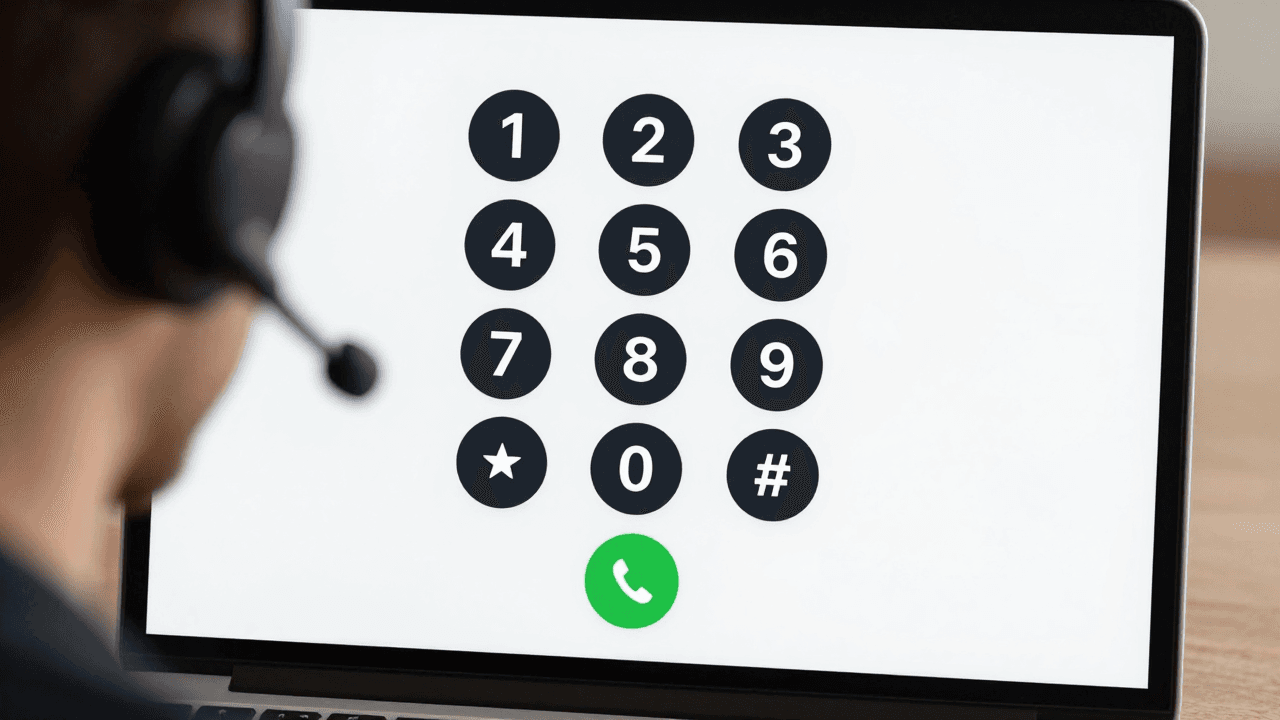
Google Voice gives you a free U.S. number and decent voicemail transcription — right up until you actually need to call a landline in another country without your bill exploding. That gap is exactly what Dialable.world was built to close. Dialable is a browser-based, audio-only calling service: no app download, no SIM card, no bloated video suite bolted on for a feature nobody asked for. Open a tab, dial a number, and the call from browser goes out over the open internet instead of a cell tower — a genuine Skype alternative for landline calls, minus the app Microsoft just shut down.
Under the hood, both services lean on WebRTC (Web Real-Time Communication), the browser standard that lets audio streams travel directly between your device and the other party without installing anything. But WebRTC is just plumbing — what you actually pay for is VoIP (Voice over Internet Protocol, the general technique of carrying voice as data packets) and, critically, the bridge into the PSTN (Public Switched Telephone Network — the traditional wired and mobile phone grid every landline and most mobile numbers still sit on). That bridge is where Google Voice and Dialable genuinely diverge.
Key Takeaways
- Dialable is audio-only and browser-native: no install, no SIM, no video call clutter.
- Google Voice's free tier is U.S.-and-Canada-centric; landline and mobile termination in most other countries is billed per minute, often at rates that surprise first-time callers.
- Dialable's per-minute landline rates in over 150 countries are built for expats, freelancers, and small teams making frequent cheap international calls to landlines, not occasional ones.
- Call quality depends on the codec (the algorithm that compresses and decompresses your voice for transmission) and latency (the delay between speaking and being heard) — both services use modern, low-latency codecs, but routing quality varies by destination.
- Neither product is a video app. Comparisons to Zoom or WhatsApp video calling do not apply here — this is strictly voice.
Why does Google Voice get expensive outside North America?
Google Voice was designed around a U.S. Google Account, a U.S. or Canadian number, and free calling within that footprint. The moment you dial a landline in, say, Portugal or the Philippines, you're billed per minute at rates Google sets per destination — and those rates can run anywhere from $0.05 to well over $0.80 a minute depending on the country and whether you're reaching a mobile or a fixed line. For a digital nomad calling a bank's landline support desk, or an expat checking in on a parent's home phone every week, that adds up fast. Dialable was built around the opposite assumption: that international landline calling is the default use case, not an edge case, so its per-minute pricing is structured for cheap international calls to landlines from day one rather than treated as a premium add-on.

Does call quality actually hold up over a browser tab?
This is the question most people ask before they'll trust either service with an important call — a visa office, a bank fraud line, a client. Both Dialable and Google Voice route audio through modern low-latency codecs (Opus is the common choice across most WebRTC-based services), which is why a stable broadband or 4G/5G connection typically delivers latency under 150 milliseconds — low enough that neither side notices a lag. Where they differ is call routing after the WebRTC leg hands off to the PSTN: Dialable's SIP (Session Initiation Protocol — the signaling standard that sets up, manages, and tears down a VoIP call) trunking is tuned specifically for landline termination quality in the country pairs its users call most, which is a narrower, more deliberate scope than Google Voice's broader but shallower global reach.
What about privacy and account requirements?
Google Voice ties your calling number to a full Google account — the same account tied to your email, calendar, and search history. Dialable takes a narrower approach: it's a purpose-built calling tool, not an identity platform, so there's less account surface tied to a single global call log. Neither approach is inherently insecure, but if you specifically want a tool that does one thing — voice calling from a browser tab — rather than a calling feature bolted onto a broader ecosystem, the scope difference matters.

Dialable vs. Google Voice vs. the rest: a quick comparison
| | Dialable | Google Voice | Skype (discontinued) | WhatsApp Calling | |---|---|---|---|---| | App required | No — browser only | App or web | Was app-only | App required | | Landline calling abroad | Purpose-built, 150+ countries | Available, priced per destination | Was available | Landline calling not supported | | Video calling | None — audio-only by design | Available | Was available | Available | | Best for | Frequent international landline/mobile calls | Free U.S./Canada calling, occasional international | N/A — shut down | Calling other WhatsApp users only |
The WhatsApp comparison matters more than it looks: WhatsApp calling only reaches other WhatsApp accounts, so it's useless the moment you need to dial world numbers that aren't on the app — a customer service line, a relative without a smartphone, a government office. Dialable and Google Voice both connect to any real phone number; the difference is cost and focus once you're actually dialing internationally.
What does it actually cost to switch a weekly call over?
Take a concrete example: a freelancer in Lisbon calling a client's landline office in Berlin once a week for a 20-minute check-in. At a blended Google Voice rate of roughly $0.12 a minute for German fixed lines, that's about $2.40 per call, or roughly $9.60 a month for four calls — manageable, but not nothing over a year. Dialable's flat, low per-minute landline rate for high-volume European routes typically lands well under half that, and because there's no app to install or account to spin up beyond signing in on the site, the switching cost is close to zero: you dial world numbers the same way, from the same browser tab, the very first time you open the page. Multiply that same freelancer's pattern across a handful of clients or family members spread over two or three countries, and the savings compound quickly enough that most users notice it on the first billing cycle, not the tenth.
FAQ
Is Dialable a Skype replacement? Functionally, yes, for voice — Dialable is one of the more direct Skype alternatives for landline calls that appeared once Skype shut down, since it covers the same core job (dial any number, in any country, from a browser) without the video-conferencing weight Skype had accumulated. Dialable never had video features to begin with, so there's nothing to strip out.
Can I use Dialable instead of Google Voice for a permanent number? Not quite — Google Voice issues you a persistent number for receiving calls and texts; Dialable is built for outbound calling from a browser, not as a number-porting or receiving service. Many users run both: Google Voice (or a local number) for receiving, Dialable for making cheap international calls to landlines.
Does Dialable work on hotel wifi or a shared coworking connection? Yes — since it's WebRTC over standard HTTPS, it works anywhere a browser loads normally, including hotel wifi and coworking spaces, without needing a VoIP port opened by an IT admin.
Why does Dialable only do audio, no video? Because video calling already has plenty of options — Zoom, WhatsApp, Google Meet — and none of them are optimized for the specific job of cheaply reaching a landline or basic mobile phone anywhere in the world. Dialable stays audio-only on purpose: one job, done well.
The bottom line
If your calling pattern is mostly domestic, Google Voice's free tier is hard to beat. But the moment international landlines become a regular part of your week — supplier calls, family check-ins, bank support lines, embassy appointments — the per-minute math tips toward a tool built specifically for that job. That's the whole premise behind Dialable.world: open a browser tab, dial world numbers directly, and let the cost of a global call stop being the reason you put off making it. Dialable is a product of AEGONTECH LLC, built for the people who call internationally often enough that it should just be simple.