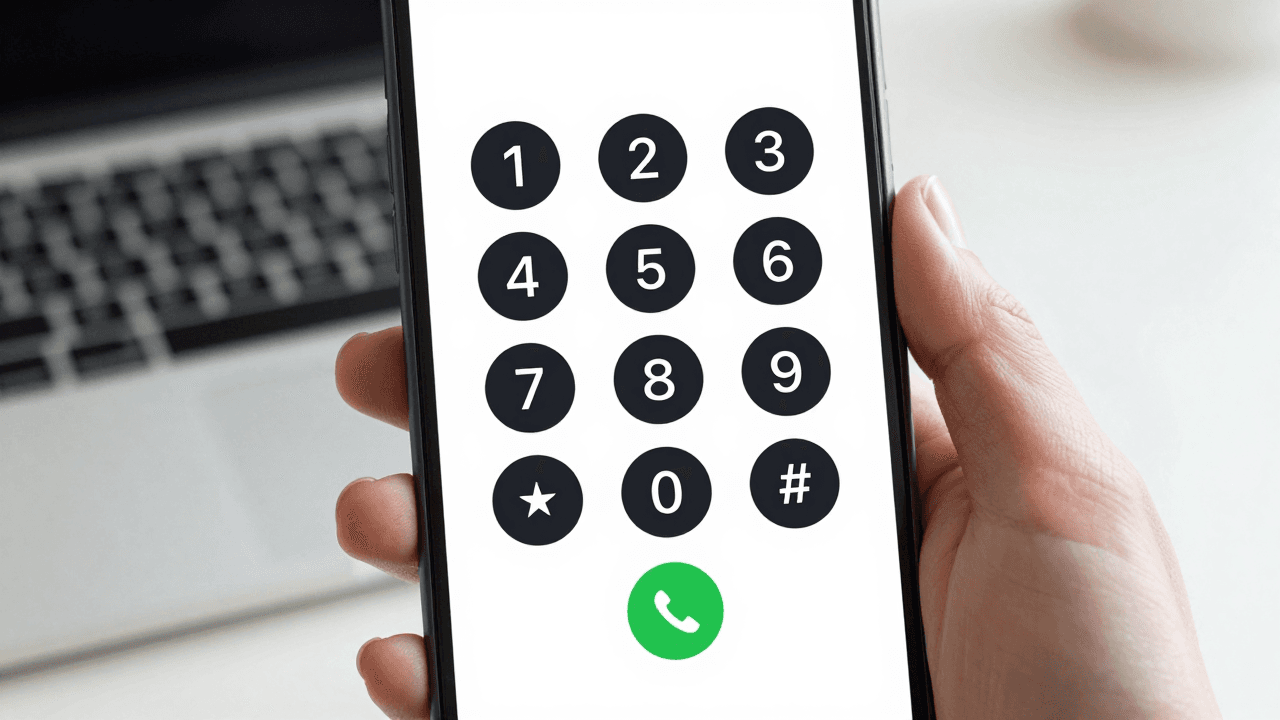
You signed the paperwork to sell your flat, or you are buying a first home, and you are doing it from 9,000 kilometres away. The title company opens at 9 a.m. its time, which is 11 p.m. yours. The notary wants a phone call before anything gets stamped. Your mobile plan charges a small fortune per minute to a foreign landline, and the "free" calling apps cannot dial a desk phone at all. This is where Dialable (https://www.dialable.world) earns its place: a browser tab, a dial pad, and a real phone number on the other end.
Key Takeaways
- A property sale or purchase back home typically involves 8 to 15 separate phone calls: agents, title or escrow offices, solicitors, notaries, lenders, and utilities.
- Almost every one of those parties answers on a landline (a traditional fixed phone line), and app-to-app tools like WhatsApp cannot reach it.
- With Dialable you call from browser, with no app download and no local SIM, so you can dial a title office from a hotel desk, a coworking space, or your kitchen table.
- Time zones are the real enemy. Plan call windows in advance, keep a written script, and log every call.
- Always check the per-minute rate to the destination before you dial, and keep calls short and prepared.
Why is handling a home sale from abroad so phone-heavy?
Email feels like the modern answer, but property transactions are stubbornly analogue. A title or escrow officer needs to confirm identity verbally. A solicitor in the UK, a notaire in France, or a closing attorney in the United States will often ask you to confirm wiring instructions by voice, because wire fraud is a well-known risk in real estate. A bank's mortgage desk may need a recorded confirmation. Your property manager wants to talk through a repair before the buyer's inspection.
Most of those offices run on PSTN, the Public Switched Telephone Network, which is the global system of landlines and mobile networks that has existed for well over a century. If you are calling a mortgage broker's front desk, you are dialling into PSTN, not into an app. That is why a "free" WhatsApp call or a chat message gets you nowhere: the receptionist does not have WhatsApp on a desk phone.
For a digital nomad or expat, the usual workaround is painful. Roam on your home SIM and pay roaming charges. Buy a local SIM for every country you pass through. Or hunt for a Skype alternative for landline calls after Skype's shutdown left a gap in the market. None of these is built for a five-minute call to a notary.
How does Dialable make a call to a landline from a browser tab?
Dialable uses WebRTC (Web Real-Time Communication), a technology built into modern browsers such as Chrome, Firefox, Safari and Edge that lets a web page capture your microphone and carry voice over the internet in real time. You open dialable.world, type the number using the on-screen keypad, and press the green call button. Dialable connects your browser audio to the regular phone network on the far end, so the other person simply sees an incoming call and picks up a normal phone.
Two things are worth knowing:
- It is audio only. Dialable is built for voice calls, nothing more. That is exactly what a title office or notary wants: a clear conversation, not a feature tour.
- It is a dial world tool, not a contact list. You can reach a landline or a mobile in a very large number of countries, which matters when your closing attorney is in one country, your buyer's bank is in another, and you are in a third.
Because the call runs through a browser, there is nothing to install on a borrowed laptop at a coworking space, and nothing to configure on a phone that is locked to a different carrier.

What does a typical property call schedule look like?
Think in terms of a calendar rather than a single call. A realistic home sale from abroad often looks like this:
- Week 1: 2 to 3 calls to a listing agent or property manager to agree on price, photos and viewings.
- Week 2: 2 calls to a solicitor or closing attorney to confirm instructions and the contract timeline.
- Week 3: 1 to 2 calls to your lender or the buyer's lender about payoff figures.
- Closing week: 2 to 4 short calls to confirm wiring details, signing logistics and key handover.
That is roughly 8 to 12 calls, and many are under ten minutes. The total talk time may be 2 to 3 hours across a month. Over that span the difference between a sensible per-minute rate and a roaming rate is real money, so it pays to plan the calls and keep each one focused.
How should you handle the time-zone gap?
A seven-hour or twelve-hour difference can quietly wreck a transaction. The title office closes at 5 p.m. their time. You are in Bali, where it is already 6 a.m. the next day. Miss the window and you wait another day, which can push back a closing date.
Practical rules that work:
- Book the call, do not hope for it. Email the office first and agree on a specific time in their time zone.
- Convert and write it down. Put both zones in your calendar, with a reminder 30 minutes before.
- Use a quiet spot with stable internet. A wired connection or a strong Wi-Fi signal matters more than the device. If you are stuck on weak hotel Wi-Fi, our guide to fixing choppy browser calls walks through the fixes.
- Try the first call during an overlap window. Mid-morning in Lisbon is early morning in New York; pick the hour that suits both sides.
What is the cost difference compared with other options?
Here is a worked example using round numbers, purely to show how the math behaves. Suppose you make 10 calls of 15 minutes each, which is 150 minutes of talk time to landlines.
| Option | Typical cost behaviour | What happens at 150 minutes | |---|---|---| | Home-carrier roaming | Per-minute roaming charges, often several times a domestic rate | The bill can be shocking, and you only see it later | | Local SIM per country | Cheap data, but you need one per country and the number changes | Setup time plus a number the other party does not recognise | | WhatsApp or app-to-app | "Free," but both sides need the app | Cannot reach a desk phone or most offices | | Google Voice | Works well for US and Canada, per-minute rates vary elsewhere | Fine if your whole transaction is domestic | | Dialable | Pay for what you use, from a browser | Predictable: check the rate first, then dial |
The point is not that one number is always cheapest. It is that cheap international calls to landlines matter most when the calls are short, specific and unavoidable, which is precisely a property deal. Check the current rate on dialable.world for the country you need before you start, and budget your call list accordingly.

How do you prepare so every call counts?
Preparation is the cheapest way to cut your bill. Before each call:
- Write a three-line goal. For example: confirm the closing date, confirm the wiring instructions by voice, confirm the signing location.
- Have documents open. Contract number, parcel or title reference, and your photo ID details in front of you.
- Ask for a name and a direct line. Write them down. Real estate offices have a lot of people; a name saves you from repeating yourself.
- Verify wiring details by voice, using a number from an independent source. Never rely solely on an emailed phone number. Call the office using a number you found on their official website.
- Send a summary email after the call. "As discussed on today's call, the closing is set for the 14th" creates a paper trail.
Frequently asked questions
Can I call a title company or solicitor's office from a browser? Yes. Offices answer on regular phone lines, and Dialable connects your browser audio to those lines, so the person on the other end sees an ordinary incoming call.
Do I need to install an app or buy a SIM? No. You open dialable.world in a modern browser, allow microphone access, and use the dial pad. Nothing needs installing.
What if the office is closed when I call? Ask for a callback window by email first, then call at the agreed time in their time zone. Dialable works from any browser, so you can place the call from wherever you are when the window opens.
How can I avoid wire fraud when the call is the verification step? Always call a number you sourced independently, such as the office's official website, and confirm account details out loud before sending money.
Making the call, not the roaming bill
Selling or buying property from abroad is stressful enough without a surprise phone bill or a missed call window. Plan the calls on a calendar, prepare a short script for each one, and use a tool that reaches the phones those offices actually answer. If you need a global call option that works from any browser, open Dialable.world, check the rate for your destination, and dial. Dialable is built by AEGONTECH LLC, and it is designed for exactly this kind of short, practical, no-fuss conversation across borders.